

Examination of Criminal Laws on Crimes Against National Security and Disruption of Public Order in Western Countries
(United States, United Kingdom, France, Germany, and Canada)
Along with relevant provisions from the United Nations Universal Declaration of Human Rights, the International Covenant on Civil and Political Rights, and European human rights standards
Recent events in the country in the intelligence and security domains indicate that the enemies and adversaries of the Islamic Republic of Iran have placed special emphasis on inciting emotions and drawing people into the streets in order to create street protests and thereby pave the way for achieving their objectives.
Investigations show that the events of the years 1396 (2017–2018), 1398 (2019–2020), 1401 (2022–2023), and 1404 (2025–2026) were nothing but street riots, chaos, and actions against the national security of the country, and they cannot be called protests.
The enemy’s media apparatus is attempting to portray these riots and disturbances as non-violent and peaceful protests and to condemn any action taken against the rioters and troublemakers.
For this reason, we have decided to examine the anti-security laws of Western countries—criminalized under the title of disruption of public order in their criminal codes—as well as international institutions, to expose the contradictions of these false claimants of human rights. At the same time, we remind supporters and institutions of the Islamic Republic of Iran of the firm and decisive measures taken by Western countries against those who disrupt security and public order, demonstrating how they have managed to control their societies and claim order and security through the enactment of strict laws.
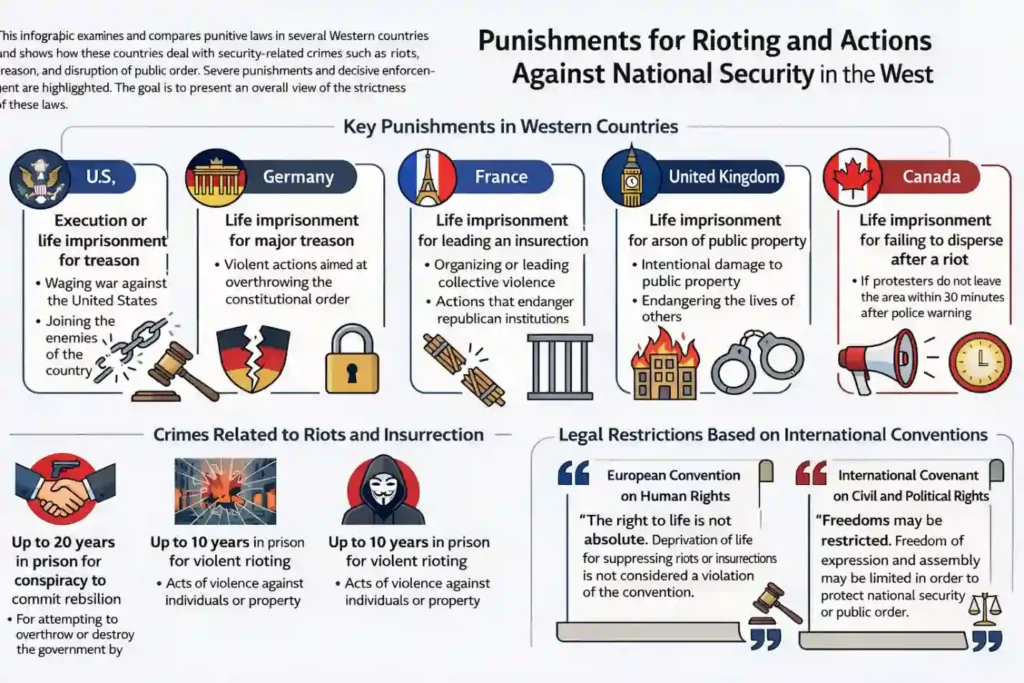
Examination of the criminal laws regarding security crimes in the United States, United Kingdom, France, Germany, and Canada shows that the judicial, security, and police apparatuses of these countries deal firmly and decisively with disruptions of public order and actions against national security.
The following are excerpts from these laws:
- Whoever rebels against the United States or incites others to rebellion and aids it shall be punished by a maximum of 10 years imprisonment, a fine, or both.
- In the United Kingdom, engaging in riotous and violent acts against the person or property of individuals in society carries a penalty of up to 10 years imprisonment, an unlimited fine, or both.
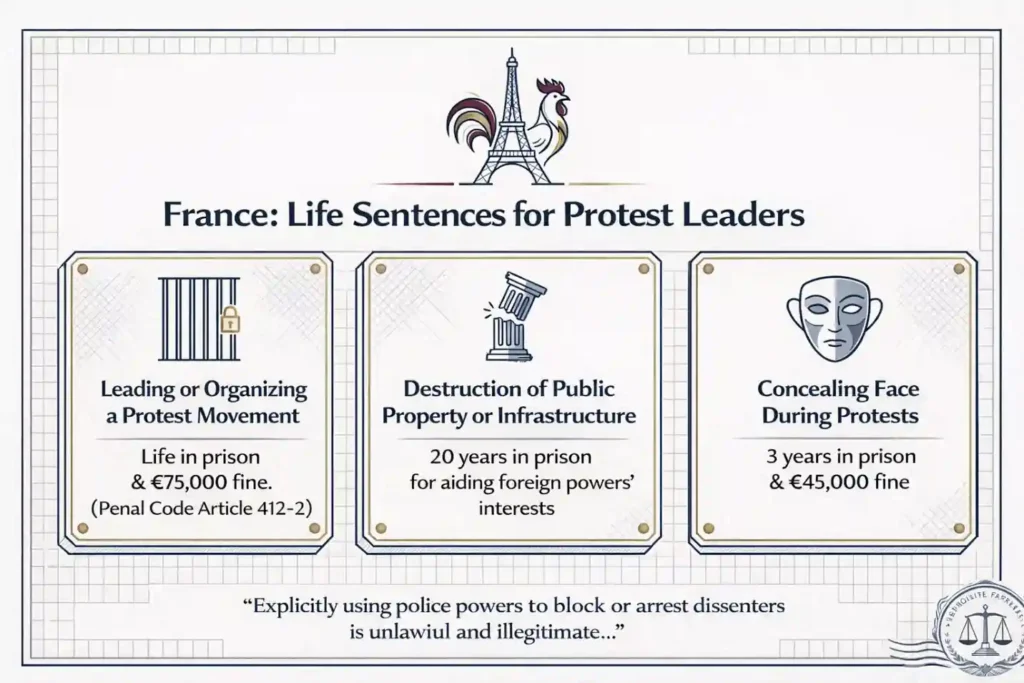
- Any collective violence that may endanger the institutions of the French Republic or undermine the integrity of the national territory constitutes an insurrectionary movement; participation in such a movement is punishable by 15 years imprisonment and a fine of 225,000 euros.
- Leadership or organization of an insurrectionary movement in France is punishable by life imprisonment and a fine of 750,000 euros.
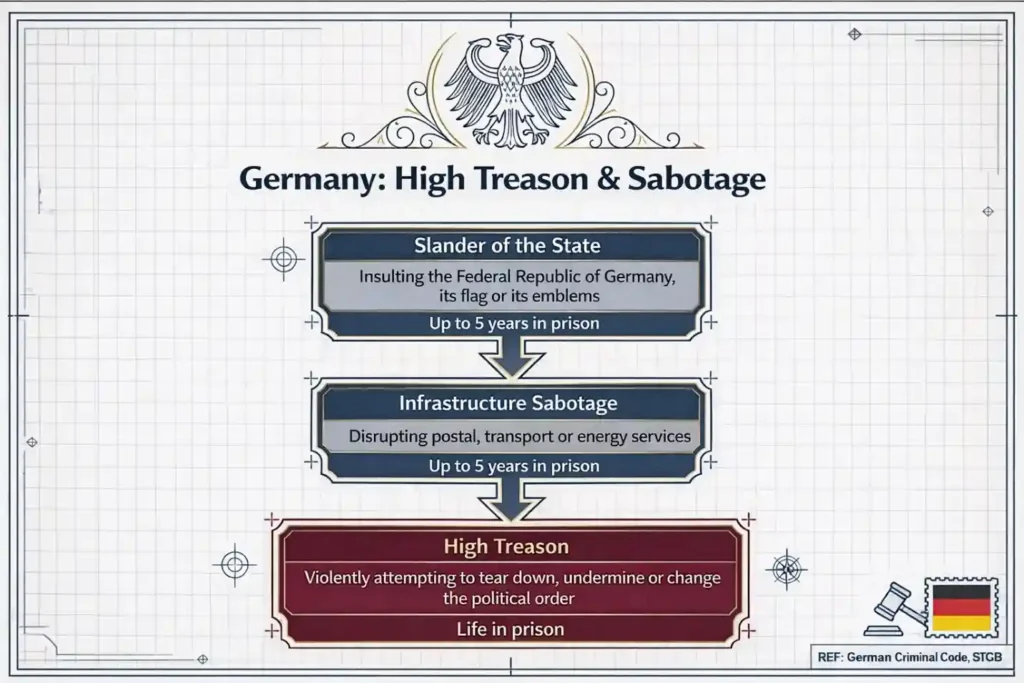
- In Germany, high treason against the government consists of “using violence or threatening to use it to destabilize the country or change the ruling system,” which carries life imprisonment.
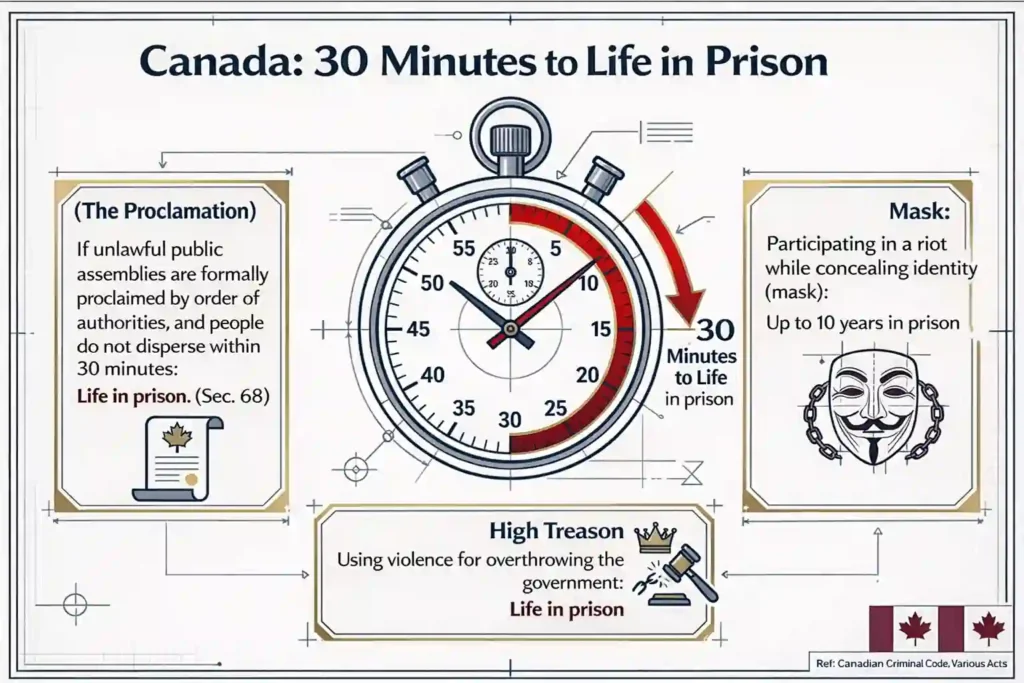
- In Canada, if a person participating in a riot or disturbance wears a mask or disguise to conceal their identity, they shall be sentenced to a maximum of 10 years imprisonment.
- In Canada, if, during an unlawful assembly, a proclamation is read by an official (such as the chief of police), and the participants do not disperse from the location within 30 minutes, they shall be liable to life imprisonment.
It should be noted that the legal arrangements in Western countries for establishing order and security in society are so firm and regulated under such conditions because: First, these countries do not face enemies similar to themselves toward other nations, including the Iranian nation. Second, they possess special dominance over telecommunications and virtual platforms through powerful intelligence services such as the NSA in the United States and GCHQ in the United Kingdom, along with specific regulations and laws for managing cyberspace. Third, these countries do not face the special conditions prevailing in the West Asia region; the surrounding conditions of Iran are considered unique (proximity to Iraq and Afghanistan under U.S. occupation, the presence of the terrorist Israeli regime in the region, the global supply of narcotics from Afghan soil, and the activity of dozens of ethnic and religious terrorist groups around Iran—supported by the West, from PJAK to Jaish al-Adl and Al-Ahwaziyeh, among others—all create a unique situation compared to stable Iran. If any negligence occurs in the security, disciplinary, or judicial spheres, the objectives of the enemies of the Iranian people will be realized).
Basic Principles on the Use of Force and Firearms by Law Enforcement Officials Adopted by the Eighth United Nations Congress on the Prevention of Crime and the Treatment of Offenders (Havana, Cuba, 27 August to 7 September 1990)
Article 4. Law enforcement officials, in carrying out their duty, shall, as far as possible, apply non-violent means before resorting to the use of force and firearms. They may use force and firearms only if other means remain ineffective or without any promise of achieving the intended result.
Article 9. Law enforcement officials shall identify themselves as such and give a clear warning of their intent to use firearms, with sufficient time for the warning to be observed, unless to do so would unduly place the law enforcement officials at risk or would create a risk of death or serious injury to other persons, or would be clearly inappropriate or pointless in the circumstances of the incident.
Article 12. In accordance with the principles set out in the Universal Declaration of Human Rights and the International Covenant on Civil and Political Rights, everyone has the right to peaceful assembly. Governments, police forces, and law enforcement officials shall recognize that the use of force and firearms is permissible only in accordance with Articles 13 and 14.
Article 13. In the dispersal of assemblies that are unlawful but non-violent, law enforcement officials shall avoid the use of force or, where that is not practicable, shall restrict such force to the minimum extent necessary.
Article 14. In the dispersal of violent assemblies, law enforcement officials may use firearms only when less dangerous means are not practicable and only to the minimum extent necessary, and in accordance with Article 9.
United States
Definition of Political Crimes
Actions such as treason, rebellion, sedition, and espionage are considered political crimes in the United States. https://www.law.cornell.edu/uscode/text/18/part-I/chapter-115
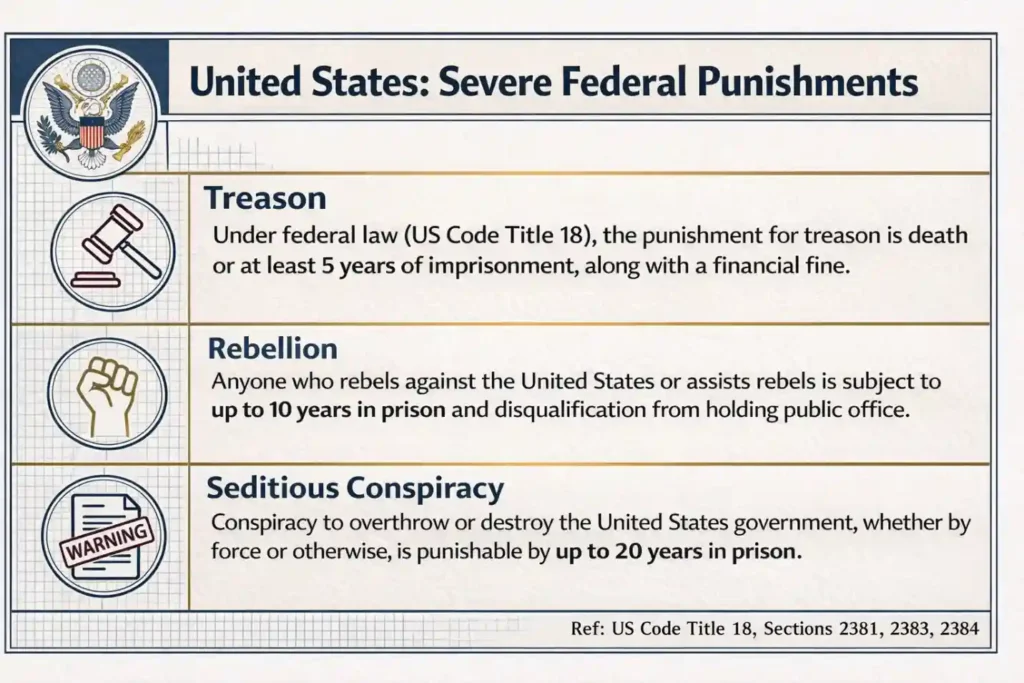
Treason: Waging war against the United States or adhering to its enemies, giving them aid and comfort. The punishment for treason under U.S. federal law is death, or imprisonment (with hard labor) for not less than five years and a fine of not less than $10,000 (and the individual is barred from holding any office under the United States while in the country).
- Whoever, owing allegiance to the United States, levies war against them or adheres to their enemies, giving them aid and comfort within the United States or elsewhere, is guilty of treason and shall suffer death, or shall be imprisoned not less than five years and fined under this title but not less than $10,000; and shall be incapable of holding any office under the United States.
- https://www.law.cornell.edu/uscode/text/18/2381
Rebellion/Insurrection: Whoever rebels against the United States or incites others to rebellion and aids it shall be punished by a maximum of 10 years imprisonment, a fine, or both. (In this offense, the individual shall be incapable of holding any office under the United States.)
- Whoever incites, sets on foot, assists, or engages in any rebellion or insurrection against the authority of the United States or the laws thereof, or gives aid or comfort thereto, shall be fined under this title or imprisoned not more than ten years, or both; and shall be incapable of holding any office under the United States.
- https://www.law.cornell.edu/uscode/text/18/2383
Sedition: Issuing any false, scandalous, and malicious statement against the government, the President, or Congress with the intent to bring them into disrepute, to excite against them the hatred of the good people of the United States, to stir up sedition, or to incite any unlawful combinations for opposing or resisting any law, or to aid, abet, or encourage any hostile designs of any foreign nation against the United States.
Seditious Conspiracy: If two or more persons in any State or Territory, or in any place subject to the jurisdiction of the United States, conspire to overthrow, put down, or to destroy by force the Government of the United States, or to levy war against them, or to oppose by force the authority thereof, or by force to prevent, hinder, or delay the execution of any law of the United States, or by force to seize, take, or possess any property of the United States contrary to the authority thereof, they shall each be fined under this title or imprisoned not more than twenty years, or both.
Sedition Penalty: A fine, a maximum of 20 years imprisonment, or both.
- If two or more persons in any State or Territory, or in any place subject to the jurisdiction of the United States, conspire to overthrow, put down, or to destroy by force the Government of the United States, or to levy war against them, or to oppose by force the authority thereof, or by force to prevent, hinder, or delay the execution of any law of the United States, or by force to seize, take, or possess any property of the United States contrary to the authority thereof, they shall each be fined under this title or imprisoned not more than twenty years, or both.
- https://www.law.cornell.edu/uscode/text/18/2384
Espionage: Obtaining any information relating to the national defense with the intent or reason to believe that the information is to be used to the injury of the United States or to the advantage of any foreign nation.
The penalty for espionage varies depending on the severity of the offense, ranging from life imprisonment and the death penalty to terms of 10 or 15 years imprisonment and fines.
Any person who attempts to communicate with any foreign government regarding the national defense of the United States shall be punished by death or life imprisonment.
- https://www.law.cornell.edu/uscode/text/18/794
- https://billofrightsinstitute.org/activities/the-espionage-act-of-1917
Definitions of the Crime of Overthrow/Subversion:
Any individual who knowingly or with prior intent supports, encourages, advises, prints, publishes, or teaches actions to overthrow or destroy the Government of the United States or any of its States by force or violence is considered a subversive/overthrower.
Any individual who attempts to organize a society, group, or assembly in which teaching, advocacy, or encouragement of the overthrow or destruction of the Government of the United States by force or violence takes place is considered a subversive/overthrower.
Penalty for the Crime of Overthrow/Subversion:
A maximum of 20 years imprisonment, a fine, or both (this individual shall not be eligible for employment by the United States Government or any of its departments or agencies for five years following conviction).
- Whoever knowingly or willfully advocates, abets, advises, or teaches the duty, necessity, desirability, or propriety of overthrowing or destroying the government of the United States or the government of any State, Territory, District or Possession thereof, or the government of any political subdivision therein, by force or violence, or by the assassination of any officer of any such government; or
- Whoever, with intent to cause the overthrow or destruction of any such government, prints, publishes, edits, issues, circulates, sells, distributes, or publicly displays any written or printed matter advocating, advising, or teaching the duty, necessity, desirability, or propriety of overthrowing or destroying any government in the United States by force or violence, or attempts to do so; or
- Whoever organizes or helps or attempts to organize any society, group, or assembly of persons who teach, advocate, or encourage the overthrow or destruction of any such government by force or violence; or becomes or is a member of, or affiliates with, any such society, group, or assembly of persons, knowing the purposes thereof—
- Shall be fined under this title or imprisoned not more than twenty years, or both, and shall be ineligible for employment by the United States or any department or agency thereof, for the five years next following his conviction.
- If two or more persons conspire to commit any offense named in this section, each shall be fined under this title or imprisoned not more than twenty years, or both, and shall be ineligible for employment by the United States or any department or agency thereof, for the five years next following his conviction.
- https://www.law.cornell.edu/uscode/text/18/2385
Use of Force and Firearms in the United States
In 2014, U.S. Customs and Border Protection (CBP) and Border Patrol published a new use-of-force policy and guidance, aligned with international standards, stating: The use of deadly force is necessary only when the officer/agent has a reasonable belief that the subject of such force poses an imminent threat of death or serious bodily injury to the officer/agent or another person.
State Actions to Restrict the Right to Protest and Increase Penalties for Unlawful Protests
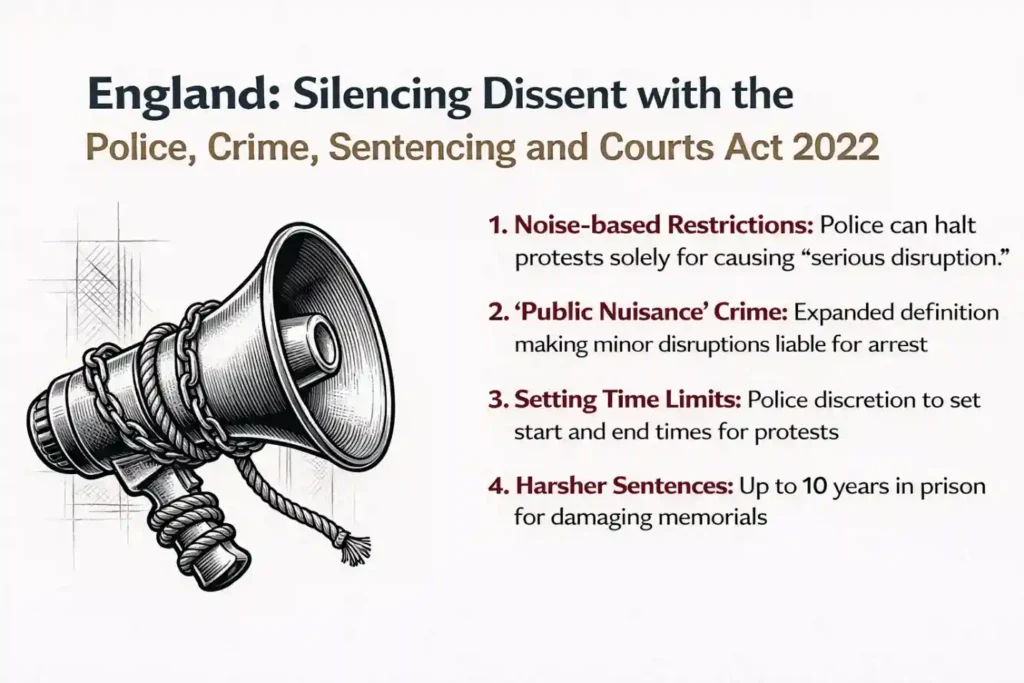
Following widespread Black protests in 2020 and thereafter, some state lawmakers took steps to limit the right to protest by expanding the types of actions for which individuals could be arrested during protests and increasing penalties for offenses committed during protests. For example, a bill in Florida with the following provisions was passed in April 2021:
Expand the definition of “riot” (a third-degree felony in Florida) to include participation in a group of three or more persons who intend to engage in disorderly or violent conduct that results in injury, property damage, or the imminent danger of such outcomes (even if the arrested person did not personally commit the disorderly or violent act, presence is considered).
Presence in a group of 25 or more protesters that endangers the safe movement of a vehicle on public roads—and potentially including temporary blocking of traffic during a protest—is considered a second-degree felony punishable by up to 15 years in prison.
Damage to or destruction of a memorial or historic site is a third-degree felony if the damage exceeds $200 in value.
Increase penalties for several other offenses when committed as part of a protest but meeting the definition of riot.
Require protesters arrested for specific offenses, including unlawful assembly, to be held in jail until a court hearing to determine bail.
Amnesty International’s 2021 Report Highlights 5 Key Points on U.S. Police Use of Deadly Force
Amnesty International, in a 2021 report (updating its earlier findings on police use of lethal force), pointed to 5 key issues regarding U.S. police use of force:
None of the U.S. states comply with international laws and standards on police use of deadly force.
In the United States, the majority of deaths caused by police result from the use of firearms.
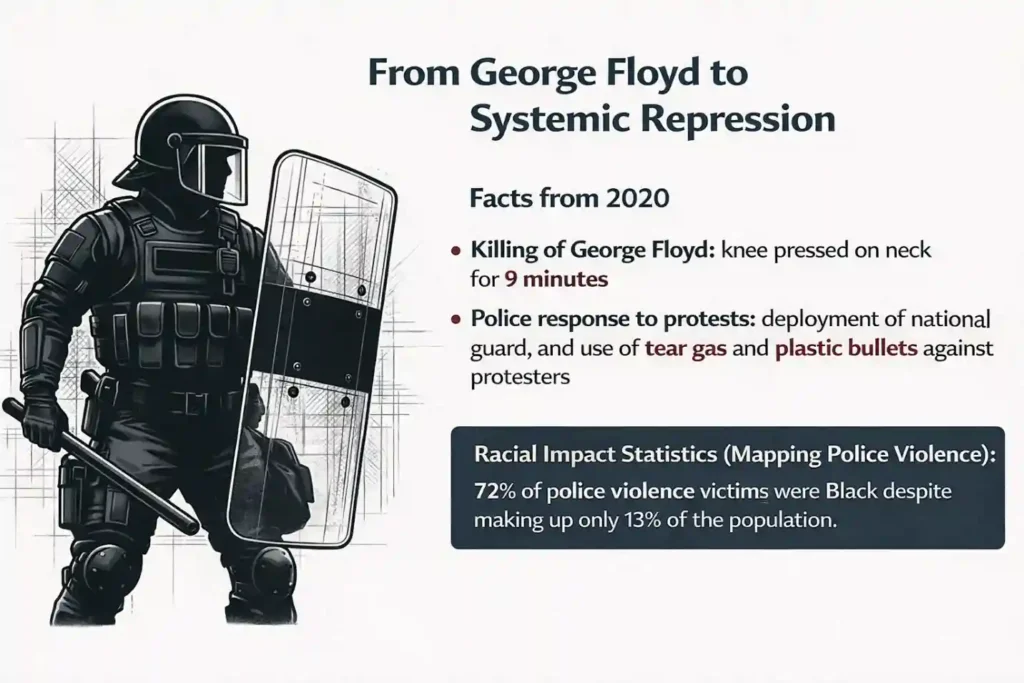
In many cases, officers fired multiple rounds at the victim, indicating that the use of firearms was unnecessary or disproportionate to the situation. For example, police fired six times at Michael Brown, who was unarmed.
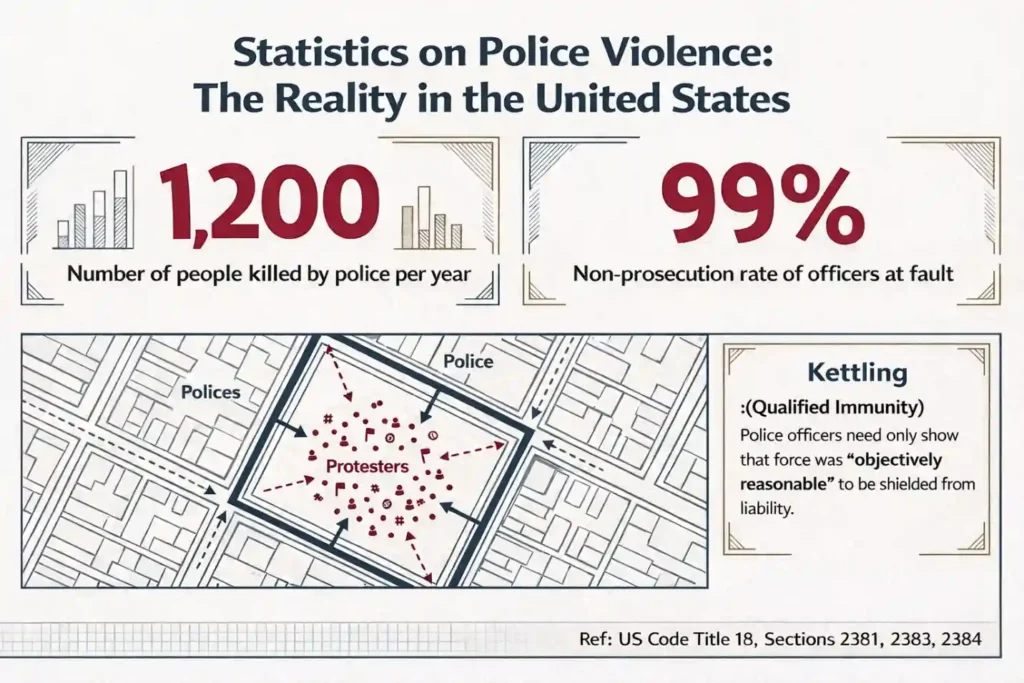
According to data from the Mapping Police Violence website, in 2019, 24% of those killed by police were Black, while Black people make up only 13% of the total population.
Police Brutality in the United States includes the use of excessive or unnecessary force by personnel when dealing with suspects and civilians. It is estimated that nearly 1,200 people are killed by police officers in the United States each year, but in approximately 99% of these cases, the officers are not charged with any crime. Most officers who kill someone while on duty are not charged with a crime and do not receive criminal convictions because they are protected by current U.S. laws.
Those implementing the so-called “Mapping Police Violence” project were able to document 7,666 cases of individuals killed by police officers between 2013 and 2016. According to civil rights activists, this figure covers 92% of all deaths caused by police. Of these, officers involved in the killings were formally prosecuted in only 99 cases, which is about 1.3% of the total statistics, and of those, only 25 officers’ prosecutions resulted in judicial convictions.
In the United States, one person is arrested every three seconds, and according to estimates from the Federal Bureau of Investigation (FBI), the number of arrests in 2018 reached ten million three hundred thousand cases.
United Kingdom
Crime of Treason
In the United Kingdom, acts such as: intending to kill the King, Queen, or heir apparent; waging war against the sovereign authority; adhering to or aiding the enemies of the sovereign authority, are clear examples of treason against the country, and the punishment is death.
(Note: The death penalty for treason was formally abolished by the Crime and Disorder Act 1998, and the maximum punishment is now life imprisonment. The Treason Act 1351 and related laws remain in force, but no executions have occurred since 1946, and the penalty shifted to life imprisonment post-1998.)
The maximum term of imprisonment for espionage-related offenses (under section 1 of the Official Secrets Act 1911) is 14 years, although longer sentences may be possible in specific cases (e.g., consecutive terms for multiple offenses).
Crime of Disorder and Riot
Engaging in riotous and violent acts against the person or property of individuals in society carries a penalty of 10 years imprisonment, an unlimited fine, or both. (Public Order Act 1986, section 1 – Riot)
Creating violent disorder carries 5 years imprisonment, an unlimited fine, or both. (Public Order Act 1986, section 2 – Violent disorder; note: the Crime and Disorder Act 1998 addressed racially aggravated offenses but did not create the core violent disorder offense, which stems from the 1986 Act.)
Using threatening or abusive words or behavior carries 6 months imprisonment or a fine.
·Fear or provocation of violence.
(1)A person is guilty of an offence if he—
(a)uses towards another person threatening, abusive or insulting words or behaviour, or
(b)distributes or displays to another person any writing, sign or other visible representation which is threatening, abusive or insulting,
with intent to cause that person to believe that immediate unlawful violence will be used against him or another by any person, or to provoke the immediate use of unlawful violence by that person or another, or whereby that person is likely to believe that such violence will be used or it is likely that such violence will be provoked.
(2)An offence under this section may be committed in a public or a private place, except that no offence is committed where the words or behaviour are used, or the writing, sign or other visible representation is distributed or displayed, by a person inside a dwelling and the other person is also inside that or another dwelling.
(3)A person guilty of an offence under this section is liable on summary conviction to imprisonment for a term not exceeding 6 months or a fine not exceeding level 5 on the standard scale or both.
Any person who assaults the police with intent to resist or prevent lawful arrest or detention of themselves or another for any offense shall, upon conviction by the court, be sentenced to imprisonment for less than two years.
· Assault with intent to resist arrest – s.38 OAPA 1861
- This offence is committed when a person assaults another person with intent to resist arrest or prevent the lawful apprehension/detention of themselves or another for any offence. It is an either way offence, which carries a maximum penalty on indictment of two years’ imprisonment and/or a fine. A charge contrary to s.38 may properly be used for assaults on persons other than police officers, for example store detectives, who may be trying to apprehend or detain an offender.
- https://www.cps.gov.uk/legal-guidance/offences-against-person-incorporating-charging-standard
Damage to private property of individuals and public property through arson carries a penalty of life imprisonment.
Under the Malicious Damage Act 1861 (which was reformed and updated by the Criminal Damage Act 1971), intentionally damaging public property through fire (and other methods) is a criminal offense. Here is a summary of the relevant provisions on damage to public property through fire under the current law:
Criminal Damage Act 1971 – Relevant Provisions on Fire and Public Property
Section 1: Destroying or damaging property
- (1) A person who without lawful excuse destroys or damages any property belonging to another intentionally or being reckless as to whether any such property would be destroyed or damaged shall be guilty of an offense.
- (2) If a person who commits intentional damage intends by the destruction or damage to endanger the life of another or is reckless as to whether the life of another would thereby be endangered, it is a more serious offense.
Note: This section includes damage by fire, destruction, pollution, or any other method.
Section 1(3): Damage to public property
If the damaged property is public property (such as government buildings, municipal property, public facilities, public vehicles, etc.), the penalty is typically more severe.
Section 4: Penalties
For simple intentional damage to property (section 1(1)): Maximum 10 years imprisonment (if tried in Crown Court).
For intentional damage with intent to endanger life or recklessness as to endangering life (section 1(2)): Life imprisonment (theoretically, though applied less frequently in practice).
If the damage is by fire, it is usually considered an aggravating factor, as it increases the risk of fire spread and threat to life.
Examples of public property under this law:
Government buildings (offices, public schools, public hospitals)
Public facilities (parks, bridges, street lights)
Public vehicles (buses, trains)
Municipal property (trash bins, public benches)
France
Definition of Political Crime
- Actions committed against the political system and against the constitution of the government and against sovereignty that disrupt the public order established by fundamental laws and the separation of powers constitute a political crime. · Complicity with a foreign power with the aim of inciting an attack or committing acts of aggression against France and endangering the institutions of the Republic or weakening the integrity of the national territory carries 30 years imprisonment and a fine of 450,000 euros. (Article 411-4 of the French Penal Code)
- Le fait d’entretenir des intelligences avec une puissance étrangère, avec une entreprise ou organisation étrangère ou sous contrôle étranger ou avec leurs agents, en vue de susciter des hostilités ou des actes d’agression contre la France, est puni de trente ans de détention criminelle et de 450 000 euros d’amende.
- Est puni des mêmes peines le fait de fournir à une puissance étrangère, à une entreprise ou une organisation étrangère ou sous contrôle étranger ou à leurs agents les moyens d’entreprendre des hostilités ou d’accomplir des actes d’agression contre la France.
Definition of Vandalism (Sabotage) · Any act of destruction, devastation, or demolition of any document, object, substance, building, etc., that leads to an attack on the fundamental interests of the nation is called sabotage, and if an individual commits this crime, they shall be sentenced to 15 years criminal imprisonment and a fine of 225,000 euros. If the commission of this crime is for the purpose of serving the interests of a foreign power or under the control of a foreign company or organization, the penalty is 20 years imprisonment and a fine of 300,000 euros. (Article 411-9 of the French Penal Code)
- Le fait de détruire, détériorer ou détourner tout document, matériel, construction, équipement, installation, appareil, dispositif technique ou système de traitement automatisé d’informations ou d’y apporter des malfaçons, lorsque ce fait est de nature à porter atteinte aux intérêts fondamentaux de la nation, est puni de quinze ans de détention criminelle et de 225 000 euros d’amende.
- Lorsqu’il est commis dans le but de servir les intérêts d’une puissance étrangère, d’une entreprise ou organisation étrangère ou sous contrôle étranger, le même fait est puni de vingt ans de détention criminelle et de 300 000 euros d’amende.
Insurrectionary Movement · Any collective violence that may endanger the institutions of the French Republic or weaken the integrity of the national territory constitutes an insurrectionary movement, and participation in such a movement carries a penalty of 15 years imprisonment and a fine of 225,000 euros. (Articles 412-3 and 412-4 of the French Penal Code)
- Constitue un mouvement insurrectionnel toute violence collective de nature à mettre en péril les institutions de la République ou à porter atteinte à l’intégrité du territoire national. Est puni de quinze ans de détention criminelle et de 225 000 euros d’amende le fait de participer à un mouvement insurrectionnel
- https://www.legifrance.gouv.fr/codes/article_lc/LEGIARTI000006418372
- https://www.legifrance.gouv.fr/codes/article_lc/LEGIARTI000006418374
- https://www.legifrance.gouv.fr/codes/article_lc/LEGIARTI000006418376
Leadership or organization of an insurrectionary movement carries life imprisonment and a fine of 750,000 euros. (Article 412-6 of the French Penal Code)
- Le fait de diriger ou d’organiser un mouvement insurrectionnel est puni de la détention criminelle à perpétuité et de 750 000 euros d’amende.
- https://www.legifrance.gouv.fr/codes/article_lc/LEGIARTI000006418378
- Opposition or violent resistance to a person holding a governmental position or an official responsible for enforcing laws in the performance of their assigned duties constitutes rebellion and is punishable by 2 years imprisonment and a 30,000 euro fine; if this rebellion is armed, it carries 5 years imprisonment and a 75,000 euro fine. (Articles 433-6, 433-7, 433-8 of the French Penal Code)
- Constitue une rébellion le fait d’opposer une résistance violente à une personne dépositaire de l’autorité publique ou chargée d’une mission de service public agissant, dans l’exercice de ses fonctions, pour l’exécution des lois, des ordres de l’autorité publique, des décisions ou mandats de justice.
- La rébellion est punie de deux ans d’emprisonnement et de 30 000 euros d’amende.
- La rébellion commise en réunion est punie de trois ans d’emprisonnement et de 45 000 euros d’amende.
- La rébellion armée est punie de cinq ans d’emprisonnement et de 75 000 euros d’amende.
- La rébellion armée commise en réunion est punie de dix ans d’emprisonnement et de 150 000 euros d’amende.
- https://www.legifrance.gouv.fr/codes/article_lc/LEGIARTI000006418557
- https://www.legifrance.gouv.fr/codes/article_lc/LEGIARTI000034114914
- https://www.legifrance.gouv.fr/codes/article_lc/LEGIARTI000006418563
Criminal Participation in Assemblies · Any gathering of people in public places and streets that may disturb public order is considered a crime, and if the participants continue to remain in the gathering after police efforts to disperse them, they shall be sentenced to 1 year imprisonment and a 15,000 euro fine. If a person in such a gathering covers all or part of their face to avoid identification or carries a weapon, they shall be sentenced to 3 years imprisonment and a 45,000 euro fine.
- Constitue un attroupement tout rassemblement de personnes sur la voie publique ou dans un lieu public susceptible de troubler l’ordre public.
- Le fait, pour celui qui n’est pas porteur d’une arme, de continuer volontairement à participer à un attroupement après les sommations est puni d’un an d’emprisonnement et de 15 000 € d’amende.
- L’infraction définie au premier alinéa est punie de trois ans d’emprisonnement et de 45 000 € d’amende lorsque son auteur dissimule volontairement en tout ou partie son visage afin de ne pas être identifié.
Germany
Political and Security Crimes · For anyone who organizes an aggressive war against Germany, life imprisonment or imprisonment exceeding 10 years is provided. (Section 80 of the German Penal Code) · Incitement to an aggressive war against Germany, whether in writing or orally, carries imprisonment from 3 months to 5 years. (Section 80 of the German Penal Code)
- Wer im räumlichen Geltungsbereich dieses Gesetzes öffentlich, in einer Versammlung oder durch Verbreiten eines Inhalts (§ 11 Absatz 3) zum Verbrechen der Aggression (§ 13 des Völkerstrafgesetzbuches) aufstachelt, wird mit Freiheitsstrafe von drei Monaten bis zu fünf Jahren bestraft.
- https://www.gesetze-im-internet.de/stgb/__80a.html
Anyone who directly provides state secrets to a foreign power is a spy and faces 1 to 15 years imprisonment (in more serious cases, life imprisonment). · High treason against the government consists of “using violence or threatening to use it to disrupt the stability of the country or change the ruling system,” which carries life imprisonment. (In less serious cases, the penalty is set at imprisonment from 1 to 10 years.) (Section 81 of the German Penal Code)
- (1) Wer es unternimmt, mit Gewalt oder durch Drohung mit Gewalt
- den Bestand der Bundesrepublik Deutschland zu beeinträchtigen oder
- die auf dem Grundgesetz der Bundesrepublik Deutschland beruhende verfassungsmäßige Ordnung zu ändern,
- wird mit lebenslanger Freiheitsstrafe oder mit Freiheitsstrafe nicht unter zehn Jahren bestraft.
- (2) In minder schweren Fällen ist die Strafe Freiheitsstrafe von einem Jahr bis zu zehn Jahren.
Violent attempt or attempt accompanied by threat of violence to separate a part of German territory or change its government carries 1 to 10 years imprisonment, and in less serious cases 6 months to 5 years imprisonment. (Section 82 of the German Penal Code)
- (1) Wer es unternimmt, mit Gewalt oder durch Drohung mit Gewalt
- das Gebiet eines Landes ganz oder zum Teil einem anderen Land der Bundesrepublik Deutschland einzuverleiben oder einen Teil eines Landes von diesem abzutrennen oder
- die auf der Verfassung eines Landes beruhende verfassungsmäßige Ordnung zu ändern,
- wird mit Freiheitsstrafe von einem Jahr bis zu zehn Jahren bestraft.
- (2) In minder schweren Fällen ist die Strafe Freiheitsstrafe von sechs Monaten bis zu fünf Jahren
Note: Assault on state or military officials is subject to imprisonment from 3 months to 5 years. · Anyone who prepares a specific institution with the aim of treason against the Federal Government of Germany shall be sentenced to imprisonment from 1 to 10 years. (Section 83 of the German Penal Code)
- 83 Vorbereitung eines hochverräterischen Unternehmens
- (1) Wer ein bestimmtes hochverräterisches Unternehmen gegen den Bund vorbereitet, wird mit Freiheitsstrafe von einem Jahr bis zu zehn Jahren, in minder schweren Fällen mit Freiheitsstrafe von einem Jahr bis zu fünf Jahren bestraft.
- (2) Wer ein bestimmtes hochverräterisches Unternehmen gegen ein Land vorbereitet, wird mit Freiheitsstrafe von drei Monaten bis zu fünf Jahren bestraft.
Anyone who, as a leader or behind-the-scenes director, intentionally disrupts postal activities, transportation, and the supply of vital energy for the people shall be sentenced to a maximum of 5 years imprisonment or a financial fine. (Section 88 of the German Penal Code)
- 88 Verfassungsfeindliche Sabotage
- (1) Wer als Rädelsführer oder Hintermann einer Gruppe oder, ohne mit einer Gruppe oder für eine solche zu handeln, als einzelner absichtlich bewirkt, daß im räumlichen Geltungsbereich dieses Gesetzes durch Störhandlungen
- Unternehmen oder Anlagen, die der öffentlichen Versorgung mit Postdienstleistungen oder dem öffentlichen Verkehr dienen,
- Telekommunikationsanlagen, die öffentlichen Zwecken dienen,
- Unternehmen oder Anlagen, die der öffentlichen Versorgung mit Wasser, Licht, Wärme oder Kraft dienen oder sonst für die Versorgung der Bevölkerung lebenswichtig sind, oder
- Dienststellen, Anlagen, Einrichtungen oder Gegenstände, die ganz oder überwiegend der öffentlichen Sicherheit oder Ordnung dienen,
- ganz oder zum Teil außer Tätigkeit gesetzt oder den bestimmungsmäßigen Zwecken entzogen werden, und sich dadurch absichtlich für Bestrebungen gegen den Bestand oder die Sicherheit der Bundesrepublik Deutschland oder gegen Verfassungsgrundsätze einsetzt, wird mit Freiheitsstrafe bis zu fünf Jahren oder mit Geldstrafe bestraft.
- (2) Der Versuch ist strafbar.
Anyone who collects state secrets with the intent of disclosure and treason shall be sentenced to imprisonment from 1 to 10 years. (Section 96 of the German Penal Code)
- 96 Landesverräterische Ausspähung; Auskundschaften von Staatsgeheimnissen
- (1) Wer sich ein Staatsgeheimnis verschafft, um es zu verraten (§ 94), wird mit Freiheitsstrafe von einem Jahr bis zu zehn Jahren bestraft.
- (2) Wer sich ein Staatsgeheimnis, das von einer amtlichen Stelle oder auf deren Veranlassung geheimgehalten wird, verschafft, um es zu offenbaren (§ 95), wird mit Freiheitsstrafe von sechs Monaten bis zu fünf Jahren bestraft. Der Versuch ist strafbar.
Anyone who publicly, in a meeting or through published written material, incites another person to commit an unlawful act shall bear responsibility as an accessory to the crime and shall be sentenced to a maximum of 5 years imprisonment or a fine. (Section 111 of the German Penal Code)
- 111 Öffentliche Aufforderung zu Straftaten
- (1) Wer öffentlich, in einer Versammlung oder durch Verbreiten eines Inhalts (§ 11 Absatz 3) zu einer rechtswidrigen Tat auffordert, wird wie ein Anstifter (§ 26) bestraft.
- (2) Bleibt die Aufforderung ohne Erfolg, so ist die Strafe Freiheitsstrafe bis zu fünf Jahren oder Geldstrafe. Die Strafe darf nicht schwerer sein als die, die für den Fall angedroht ist, daß die Aufforderung Erfolg hat (Absatz 1); § 49 Abs. 1 Nr. 2 ist anzuwenden.
- https://www.gesetze-im-internet.de/stgb/__111.html
- Insulting the State and Symbols · Anyone who publicly, in a meeting or through published content, uses insulting language against the Federal Republic of Germany or one of its states or its constitutional order shall be sentenced to a maximum of 3 years imprisonment or a fine.
- Anyone who insults the colors, flag, national emblem, or anthem of the Federal Republic of Germany or one of its states shall be punished by 3 years imprisonment or a fine.
- 90a Verunglimpfung des Staates und seiner Symbole
- (1) Wer öffentlich, in einer Versammlung oder durch Verbreiten eines Inhalts (§ 11 Absatz 3)
- die Bundesrepublik Deutschland oder eines ihrer Länder oder ihre verfassungsmäßige Ordnung beschimpft oder böswillig verächtlich macht oder
- die Farben, die Flagge, das Wappen oder die Hymne der Bundesrepublik Deutschland oder eines ihrer Länder verunglimpft,
- wird mit Freiheitsstrafe bis zu drei Jahren oder mit Geldstrafe bestraft.
- (3) Die Strafe ist Freiheitsstrafe bis zu fünf Jahren oder Geldstrafe, wenn der Täter sich durch die Tat absichtlich für Bestrebungen gegen den Bestand der Bundesrepublik Deutschland oder gegen Verfassungsgrundsätze einsetzt.
Parties that seek to damage or eliminate the basic free democratic order or endanger the existence of the Federal Republic of Germany shall be contrary to the German Constitution and illegal.
- (2) Parteien, die nach ihren Zielen oder nach dem Verhalten ihrer Anhänger darauf ausgehen, die freiheitliche demokratische Grundordnung zu beeinträchtigen oder zu beseitigen oder den Bestand der Bundesrepublik Deutschland zu gefährden, sind verfassungswidrig.
Insult to Sacred Things · Any individual who publicly or through published material insults or blasphemes in a way that is capable of disturbing public peace, infringing on the religious beliefs or worldview of others shall be fined or sentenced to up to 3 years imprisonment for the crime of insulting sacred things.
- (1) Wer öffentlich oder durch Verbreiten eines Inhalts (§ 11 Absatz 3) den Inhalt des religiösen oder weltanschaulichen Bekenntnisses anderer in einer Weise beschimpft, die geeignet ist, den öffentlichen Frieden zu stören, wird mit Freiheitsstrafe bis zu drei Jahren oder mit Geldstrafe bestraft.
- Anyone who expresses or publishes false and distorted propaganda and claims with the intent of disrupting the functioning of the Federal Armed Forces of Germany commits a crime punishable by 5 years imprisonment or a fine.
- https://www.gesetze-im-internet.de/englisch_vstgb/englisch_vstgb.html
- https://www.gesetze-im-internet.de/stgb/BJNR001270871.html
- Any insult, threat, and publication of false content in cyberspace (internet) is a crime, and even likers of such posts are subject to punishment (fines up to 50 million euros).
- https://www.anwalt.de/rechtstipps/wann-ist-eine-beleidigung-im-internet-strafbar_186289.html
- https://www.hrw.org/news/2018/02/14/germany-flawed-social-media-law
- Performing the Nazi military salute is a crime and carries 3 years imprisonment or a fine.
- https://www.washingtonpost.com/news/worldviews/wp/2017/08/13/an-american-tourist-gave-the-nazi-salute-in-germany-so-a-stranger-beat-him-up-police-say/
- https://www.reuters.com/article/cnews-us-germany-military-idCAKBN17B0KR-OCATP
- Denial of the Holocaust and incitement of hatred carries 6 months imprisonment.
https://www.yadvashem.org/holocaust/holocaust-antisemitism/holocaust-denial-laws.html
Canada
Crime of Treason · Preparing and waging war against Canada, using force to overthrow the government of Canada or any of its provinces, and providing military information to other countries constitutes treason, and the punishment is life imprisonment; in less serious cases, a maximum of 14 years imprisonment.
- https://laws-lois.justice.gc.ca/eng/acts/C-46/section-46.html
- https://www.thecanadianencyclopedia.ca/en/article/treason
Riot or Insurrection · An unlawful assembly is one that tumultuously begins to disturb the peace and carries a maximum of 2 years imprisonment. · If a person participating in a riot or disturbance wears a mask or disguise to conceal their identity, they shall be sentenced to a maximum of 10 years imprisonment. (Section 65 of the Criminal Code)
- Every person who takes part in a riot is guilty of
- (a) an indictable offence and liable to imprisonment for a term of not more than two years; or
- (b) an offence punishable on summary conviction.
- Marginal note:Concealment of identity
- (2) Every person who commits an offence under subsection (1) while wearing a mask or other disguise to conceal their identity without lawful excuse is guilty of
- (a) an indictable offence and liable to imprisonment for a term of not more than 10 years; or
- (b) an offence punishable on summary conviction.
Legal Note: If, during unlawful assemblies, a proclamation is read by an official (such as the chief of police), and the participants do not leave the location within 30 minutes, they shall be liable to life imprisonment.
- Marginal note:Reading proclamation
67 A person who is
- (a) a justice, mayor or sheriff, or the lawful deputy of a mayor or sheriff,
- (b) a warden or deputy warden of a prison, or
- (c) the institutional head of a penitentiary, as those expressions are defined in subsection 2(1) of the Corrections and Conditional Release Act, or that person’s deputy,
- who receives notice that, at any place within the jurisdiction of the person, twelve or more persons are unlawfully and riotously assembled together shall go to that place and, after approaching as near as is safe, if the person is satisfied that a riot is in progress, shall command silence and thereupon make or cause to be made in a loud voice a proclamation in the following words or to the like effect:
- Her Majesty the Queen charges and commands all persons being assembled immediately to disperse and peaceably to depart to their habitations or to their lawful business on the pain of being guilty of an offence for which, on conviction, they may be sentenced to imprisonment for life. GOD SAVE THE QUEEN.
- 68 Every one is guilty of an indictable offence and liable to imprisonment for life who
- (a) opposes, hinders or assaults, wilfully and with force, a person who begins to make or is about to begin to make or is making the proclamation referred to in section 67 so that it is not made;
- (b) does not peaceably disperse and depart from a place where the proclamation referred to in section 67 is made within thirty minutes after it is made; or
- (c) does not depart from a place within thirty minutes when he has reasonable grounds to believe that the proclamation referred to in section 67 would have been made in that place if some person had not opposed, hindered or assaulted, wilfully and with force, a person who would have made it.
- https://laws-lois.justice.gc.ca/eng/acts/c-46/page-7.html
- https://laws-lois.justice.gc.ca/eng/acts/C-46/section-67.html
Summary and Analysis of Sections 67 and 68 of the Law (with reference to the translation) These legal provisions define the formal procedures for “reading the dispersal proclamation” and the consequences of non-compliance in the face of a riot. This procedure is an essential legal step before the use of broader force to disperse a crowd.
- Section 67 (Order and Procedure for the Proclamation): This section specifies the duties of authorized officials (such as justices of the peace, mayors, sheriffs, prison wardens, and their lawful deputies). Upon being informed of an unlawful and riotous assembly of 12 or more persons in their jurisdiction, they must personally go to the location and, upon confirming a riot, issue a command for silence and then read aloud an official proclamation ordering those present to disperse within a specified time (mentioned in the following section). The content of the proclamation explicitly warns that disobedience may lead to life imprisonment. This procedure demonstrates the law’s emphasis on clear prior warning and providing an opportunity for voluntary dispersal before coercive measures are taken.
- Section 68 (Offenses and Penalties for Non-Compliance): This section defines three separate and serious offenses following the proclamation under section 67, each punishable by life imprisonment: (a) Preventing the reading of the proclamation: Intentionally opposing, preventing, or violently attacking a person who intends to read, is reading, or begins to read the proclamation in such a way that it prevents its announcement. (b) Failure to disperse after the proclamation: Refusing to peacefully disperse and leave the location within 30 minutes after the proclamation has been read. (c) Failure to leave if the proclamation could not be read: In cases where, due to attack or obstruction of the official (as in clause a), the proclamation was not actually read, if a person has reasonable grounds to believe that the proclamation would have been read in that location, they are required to leave within 30 minutes. This clause expands the scope of the law and eliminates the possibility of evading punishment by physically preventing the procedure.
Sections 46 and 47 of the Criminal Code of Canada define the most serious crimes against national security—namely “high treason” and “treason”—and prescribe mandatory life imprisonment with a minimum of 25 years before eligibility for parole. These crimes include acts such as killing or attempting to kill high officials of the country, waging war or assisting an enemy against Canada. At a lower level, section 59 criminalizes willful denial of Canadian citizenship (such as serving in an enemy army during wartime) with up to five years imprisonment. Section 63 also defines the crime of “sedition,” which includes promoting violence to change the government or legal institutions, punishable by up to fourteen years imprisonment. This section explicitly excludes peaceful criticism of the government from the scope of the crime. Overall, these provisions create a strong legal framework for preserving sovereignty, national security, and territorial integrity in Canada, while maintaining a delicate balance between protecting the lawful government and preserving the right to non-violent criticism.
Section 63 – Sedition (1) Sedition consists of:
- (a) Creating or promoting dissatisfaction or opposition against the government or legal institutions of Canada or a province;
- (b) Encouraging change by resort to violence instead of legal means.
(2) Anyone who intentionally incites sedition by word or deed commits an indictable offense and shall be sentenced to imprisonment for up to fourteen years. (3) Peaceful criticism of the government or its policies, provided it is not intended to incite violence, is not considered sedition.
Seditious Libel / Incitement · Anyone who utters or publishes seditious words or supports a seditious conspiracy commits a crime and shall be sentenced to a maximum of 14 years imprisonment. (Section 61 of the Criminal Code)
- Punishment of seditious offences
- 61 Every one who
- (a) speaks seditious words,
- (b) publishes a seditious libel, or
- (c) is a party to a seditious conspiracy,
- is guilty of an indictable offence and liable to imprisonment for a term not exceeding fourteen years.
Hate Speech · Hate propaganda, whether oral, written, or virtual, is prohibited and punishable by a maximum of 2 years imprisonment. (Section 319 of the Criminal Code; note: this covers willful promotion of hatred against identifiable groups, including recent amendments for antisemitism via Holocaust denial/downplaying.)
- Offence
- 296 (1) Every one who publishes a blasphemous libel is guilty of an indictable offence and liable to imprisonment for a term not exceeding two years.
Use of Explosive Substances · Anyone who takes action with the intent to cause an explosion of an explosive substance that is likely to cause serious bodily harm to persons or property commits a crime punishable by life imprisonment; in less serious cases, a maximum of 14 years imprisonment.
Section 82(1) of the Criminal Code (Definitions section) provides: Translation of Section 82(1): “Explosive substance” includes the following:
- (a) Anything intended for use in making an explosive substance;
- (b) Anything, or any part thereof, that has been used or is intended to be used, or adapted for use, in creating or assisting in creating an explosion with an explosive substance; and
- (c) An incendiary charge or device, whether or not intended to function as an explosive substance.
Criminal Protection for Peace Officers in Canadian Criminal Law In the Canadian legal system, the term “peace officer” has a broad meaning that extends beyond ordinary police officers and encompasses a wide range of law enforcement officials. According to the definition in section 2(1) of the Criminal Code, this title includes, in addition to police officers, customs officers, prison officers, environmental protection officers, mayors, and even captains of Canadian ships on the high seas. These individuals have special powers under the law to enforce the law, and correspondingly, heavy criminal penalties are provided to protect them while performing their duties.
The most important protective provision is section 270 of the Criminal Code, which introduces “assault on a peace officer” as an indictable offense punishable by up to five years imprisonment. This protection increases to heavier penalties in more serious cases. For example, if the assault involves a weapon or causes bodily harm, under section 269.1, life imprisonment may be applied. The most severe legal response applies to the murder of a peace officer in the line of duty, which under paragraph 231(5)(b) is automatically classified as first-degree murder and carries mandatory life imprisonment with a minimum of 25 years before parole eligibility. In addition, section 129 criminalizes any intentional obstruction of a peace officer’s lawful duties, punishable by up to two years imprisonment.
Right to Use Force by Peace Officers: Legal Framework In contrast to these criminal protections, the Criminal Code establishes a clear framework for the right of peace officers to use force. Section 25(1) provides that if a peace officer performs an act for the purpose of enforcing the law and uses force in doing so, provided the act is within their legal duties and the amount of force used does not exceed what is reasonable and necessary, they are exempt from criminal and civil liability. This principle forms the cornerstone of the legitimacy of police actions in the field. The section emphasizes that this immunity is lost if the peace officer intentionally uses excessive force or employs unauthorized means. Thus, the law clearly distinguishes between “reasonable use of force” necessary for duty and “excessive and unlawful use of force.” This framework seeks to balance the necessity of state authority in law enforcement with the protection of citizens’ rights and safety.
Willful Promotion of Antisemitism · Anyone who, by making statements other than in private conversation, willfully promotes antisemitism by condoning, denying, or downplaying the Holocaust commits a crime and shall be sentenced to imprisonment for a maximum of 2 years. (Section 319 of the Criminal Code)
Note: Such laws in European legal systems (and similar in Canada) are enacted ostensibly to protect against antisemitism, but in reality, their aim is to safeguard global Zionism under the guise of opposing antisemitism, while hundreds of books, magazines, and films are produced promoting Islamophobia, insulting Muslim and Christian sacred things, without any laws against them, and they are regarded as freedom of expression!
- 319 (1) Every one who, by communicating statements in any public place, incites hatred against any identifiable group where such incitement is likely to lead to a breach of the peace is guilty of
- (a) an indictable offence and is liable to imprisonment for a term not exceeding two years; or
- (b) an offence punishable on summary conviction.
- Marginal note:Wilful promotion of hatred
- (2) Every one who, by communicating statements, other than in private conversation, wilfully promotes hatred against any identifiable group is guilty of
- (a) an indictable offence and is liable to imprisonment for a term not exceeding two years; or
- (b) an offence punishable on summary conviction.
- Marginal note:Wilful promotion of antisemitism
- (2.1) Everyone who, by communicating statements, other than in private conversation, wilfully promotes antisemitism by condoning, denying or downplaying the Holocaust
- (a) is guilty of an indictable offence and liable to imprisonment for a term not exceeding two years; or
- (b) is guilty of an offence punishable on summary conviction.
Universal Declaration of Human Rights 1948 · Article 20
- Everyone has the right to freedom of peaceful assembly and association.
- No one may be compelled to belong to an association.
Article 20
- Everyone has the right to freedom of peaceful assembly and association.
(2) No one may be compelled to belong to an association.
- Article 29
- Everyone has duties to the community in which alone the free and full development of his personality is possible.
- In the exercise of his rights and freedoms, everyone shall be subject only to such limitations as are determined by law solely for the purpose of securing due recognition and respect for the rights and freedoms of others and of meeting the just requirements of morality, public order and the general welfare in a democratic society.
- These rights and freedoms may in no case be exercised contrary to the purposes and principles of the United Nations.
Article 29
- Everyone has duties to the community in which alone the free and full development of his personality is possible.
- In the exercise of his rights and freedoms, everyone shall be subject only to such limitations as are determined by law solely for the purpose of securing due recognition and respect for the rights and freedoms of others and of meeting the just requirements of morality, public order and the general welfare in a democratic society.
- These rights and freedoms may in no case be exercised contrary to the purposes and principles of the United Nations.
******************************************************************
International Covenant on Civil and Political Rights Adopted on 16 December 1966 (corresponding to 25/9/1345 solar) by the General Assembly of the United Nations
Article 18 Paragraph 3: Freedom to manifest one’s religion or beliefs may be subject only to such limitations as are prescribed by law and are necessary to protect public safety, order, health, or morals or the fundamental rights and freedoms of others.
Article 18
- Freedom to manifest one’s religion or beliefs may be subject only to such limitations as are prescribed by law and are necessary to protect public safety, order, health, or morals or the fundamental rights and freedoms of others.
- Article 19 Paragraph 2: Everyone shall have the right to freedom of expression; this right shall include freedom to seek, receive and impart information and ideas of all kinds, regardless of frontiers, either orally, in writing or in print, in the form of art, or through any other media of his choice.
Paragraph 3: The exercise of the rights provided for in paragraph 2 of this article carries special duties and responsibilities. It may therefore be subject to certain restrictions, but these shall only be such as are provided by law and are necessary:
(a) For respect of the rights or reputations of others;
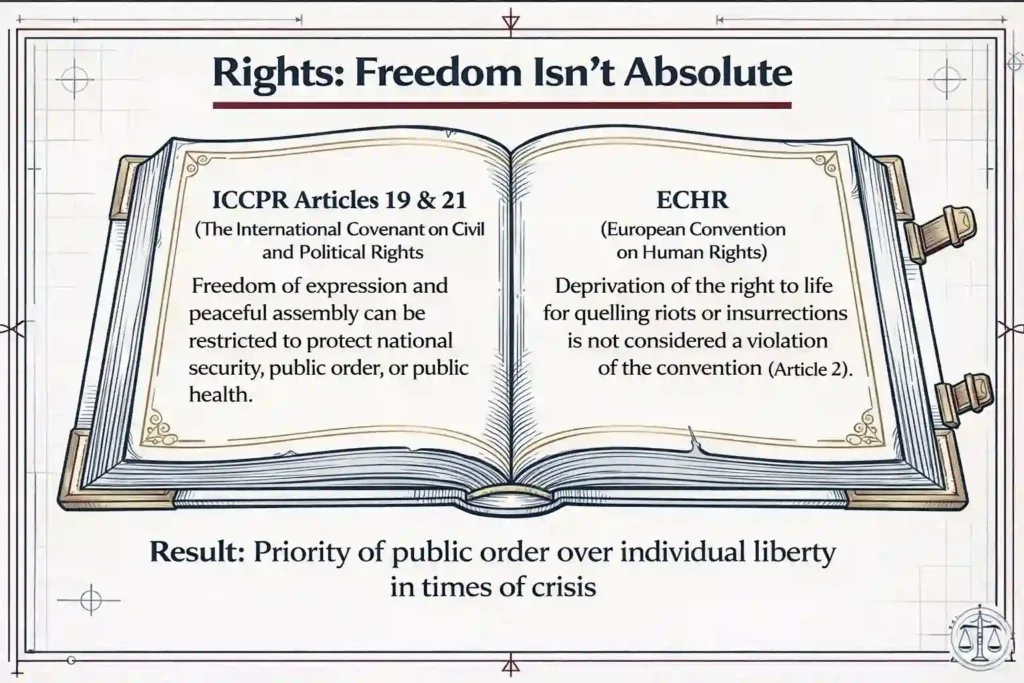
(b) For the protection of national security or of public order (ordre public), or of public health or morals.
Article 19
- Everyone shall have the right to freedom of expression; this right shall include freedom to seek, receive and impart information and ideas of all kinds, regardless of frontiers, either orally, in writing or in print, in the form of art, or through any other media of his choice.
- The exercise of the rights provided for in paragraph 2 of this article carries with it special duties and responsibilities. It may therefore be subject to certain restrictions, but these shall only be such as are provided by law and are necessary:
(a) For respect of the rights or reputations of others;
(b) For the protection of national security or of public order (ordre public), or of public health or morals.
Article 21 The right of peaceful assembly shall be recognized. No restrictions may be placed on the exercise of this right other than those imposed in conformity with the law and which are necessary in a democratic society in the interests of national security or public safety, public order (ordre public), the protection of public health or morals or the protection of the rights and freedoms of others.
Article 21
The right of peaceful assembly shall be recognized. No restrictions may be placed on the exercise of this right other than those imposed in conformity with the law and which are necessary in a democratic society in the interests of national security or public safety, public order (ordre public), the protection of public health or morals or the protection of the rights and freedoms of others.
Article 22 Paragraph 1: Everyone shall have the right to freedom of association with others, including the right to form and join trade unions for the protection of his interests.
Paragraph 2: No restrictions may be placed on the exercise of this right other than those which are prescribed by law and which are necessary in a democratic society in the interests of national security or public safety, public order (ordre public), the protection of public health or morals or the protection of the rights and freedoms of others. This article shall not prevent the imposition of lawful restrictions on members of the armed forces and of the police in their exercise of this right.
Article 22
- Everyone shall have the right to freedom of association with others, including the right to form and join trade unions for the protection of his interests.
- No restrictions may be placed on the exercise of this right other than those which are prescribed by law and which are necessary in a democratic society in the interests of national security or public safety, public order (ordre public), the protection of public health or morals or the protection of the rights and freedoms of others. This article shall not prevent the imposition of lawful restrictions on members of the armed forces and of the police in their exercise of this right.
European Convention on Human Rights
Study of provisions from the “European Convention on Human Rights,” adopted two years after the Universal Declaration of Human Rights in 1950 and still in force, reflecting the perspective of European jurists in support of freedom and human rights, while addressing rebellion, insurrection, obedience of all assemblies to police and armed forces instructions, and the use of force to preserve territorial integrity, order, and security in the following cases:
- Article 2 – Right to life
- Everyone’s right to life shall be protected by law. No one shall be deprived of his life intentionally save in the execution of a sentence of a court following his conviction of a crime for which this penalty is provided by law.
- Deprivation of life shall not be regarded as inflicted in contravention of this Article when it results from the use of force which is no more than absolutely necessary: (a) in defence of any person from unlawful violence; (b) in order to effect a lawful arrest or to prevent the escape of a person lawfully detained; (c) in action lawfully taken for the purpose of quelling a riot or insurrection.
- Article 10 – Freedom of expression
- Everyone has the right to freedom of expression. This right shall include freedom to hold opinions and to receive and impart information and ideas without interference by public authority and regardless of frontiers. This Article shall not prevent States from requiring the licensing of broadcasting, television or cinema enterprises.
- The exercise of these freedoms, since it carries with it duties and responsibilities, may be subject to such formalities, conditions, restrictions or penalties as are prescribed by law and are necessary in a democratic society, in the interests of national security, territorial integrity or public safety, for the prevention of disorder or crime, for the protection of health or morals, for the protection of the reputation or rights of others, for preventing the disclosure of information received in confidence, or for maintaining the authority and impartiality of the judiciary
Article 10
Freedom of expression
- Everyone has the right to freedom of expression. This right shall include freedom to hold opinions and to receive and impart information and ideas without interference by public authority and regardless of frontiers. This Article shall not prevent States from requiring the licensing of broadcasting, television or cinema enterprises.
- The exercise of these freedoms, since it carries with it duties and responsibilities, may be subject to such formalities, conditions, restrictions or penalties as are prescribed by law and are necessary in a democratic society, in the interests of national security, territorial integrity or public safety, for the prevention of disorder or crime, for the protection of health or morals, for the protection of the reputation or rights of others, for preventing the disclosure of information received in confidence, or for maintaining the authority and impartiality of the judiciary.
Article 11 – Freedom of assembly and association
- Everyone has the right to freedom of peaceful assembly and to freedom of association with others, including the right to form and to join trade unions for the protection of his interests.
- No restrictions shall be placed on the exercise of these rights other than such as are prescribed by law and are necessary in a democratic society in the interests of national security or public safety, for the prevention of disorder or crime, for the protection of health or morals or for the protection of the rights and freedoms of others. This Article shall not prevent the imposition of lawful restrictions on the exercise of these rights by members of the armed forces, of the police or of the administration of the State.
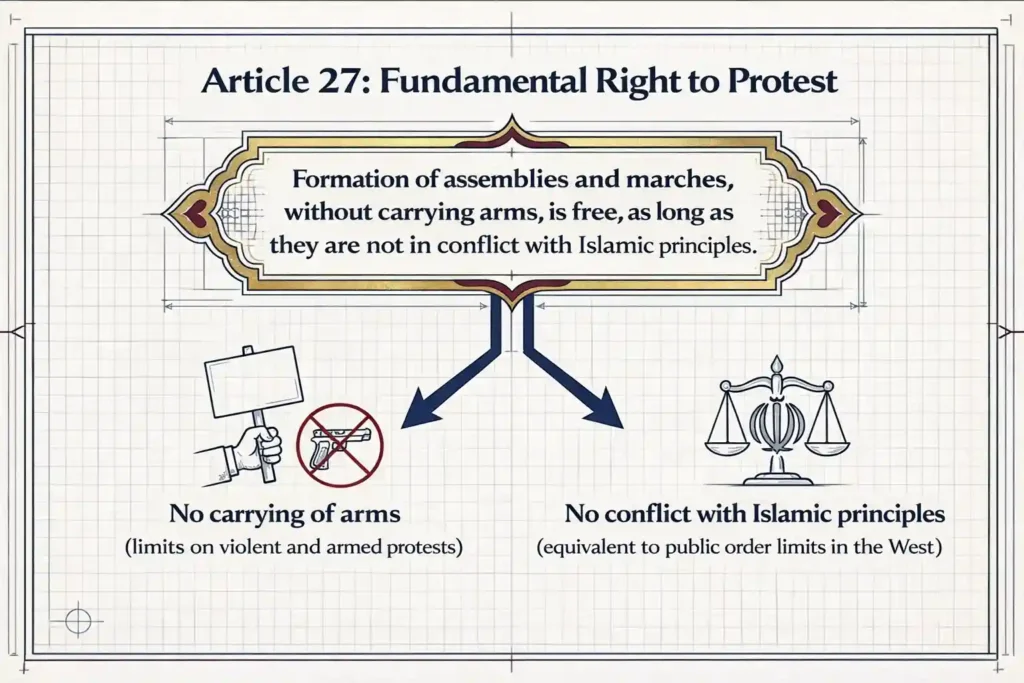
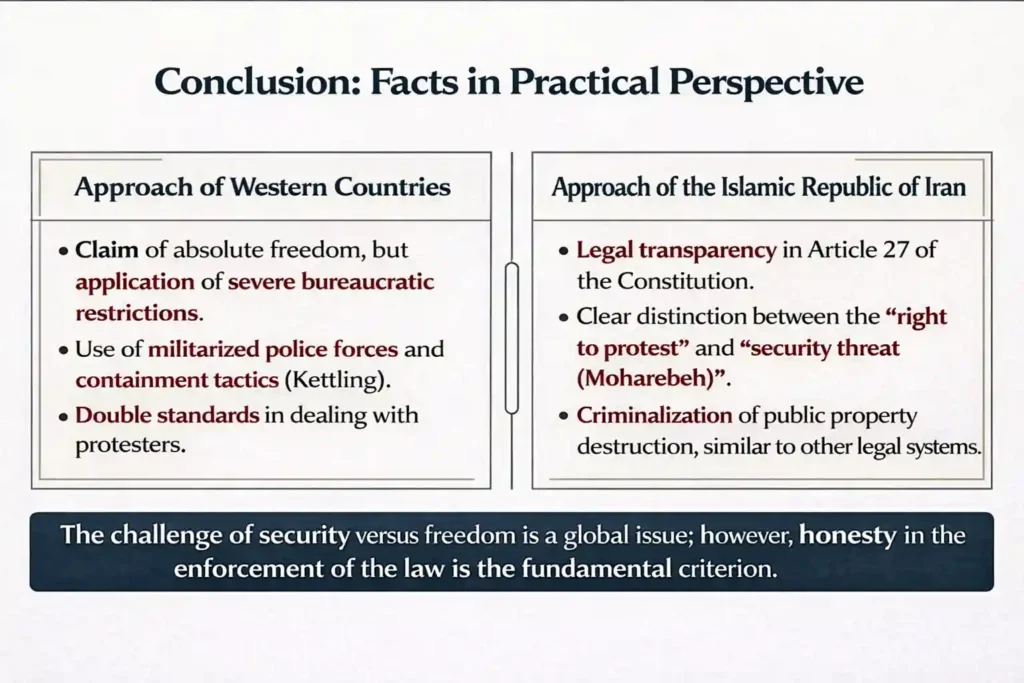
Islamic Republic of Iran and Confronting Disturbances According to the Law · In accordance with Article 27 of the Constitution, the formation of assemblies and marches without carrying arms is free, provided that it does not violate the principles of Islam.
· Punishment of rioters, disruptors of national security, and destroyers according to the Islamic Penal Code:
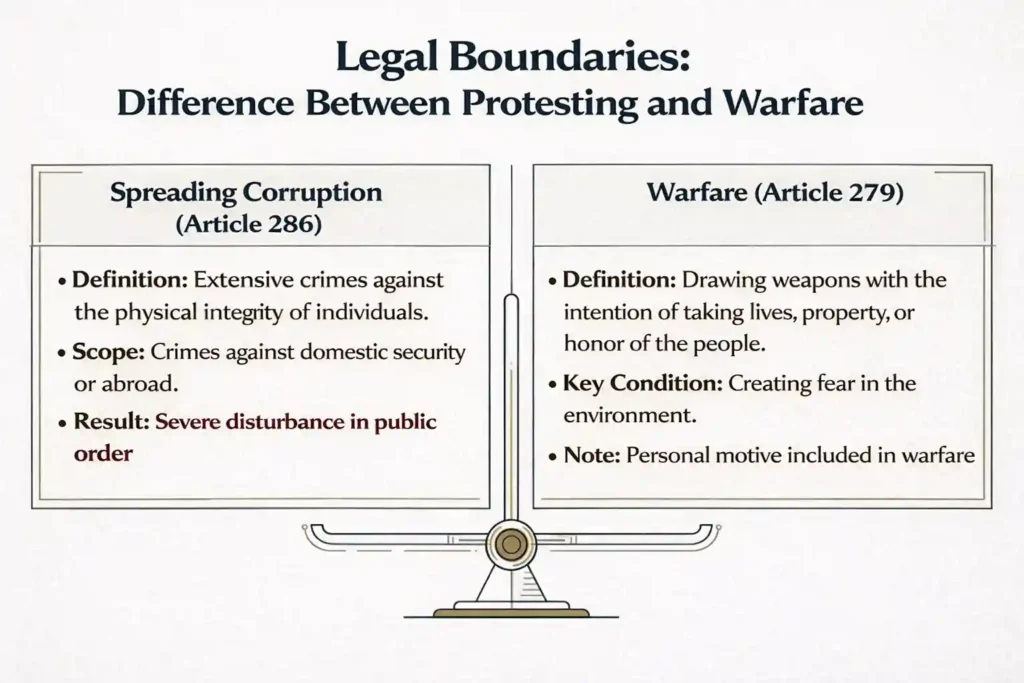
Article 279 – Moharebeh consists of drawing a weapon with the intent to endanger the life, property, or honor of people or to intimidate them in a way that causes insecurity in the environment. If someone draws a weapon against one or more specific persons with personal motives and the act does not have a public aspect, or if someone draws a weapon against people but due to incapacity does not cause insecurity, they are not considered a mohareb.
Article 286 – Anyone who extensively commits crimes against the physical integrity of individuals, crimes against the internal or external security of the country, spreading lies, disruption of the economic system of the country, arson and destruction, dissemination of poisonous, microbial, and dangerous substances, or establishing centers of corruption and prostitution or assisting in them, in such a way that it causes severe disruption in public order, insecurity, or major damage to the physical integrity of individuals or public and private property, or spreads corruption or prostitution on a wide scale, is considered mofsed fel-arz and sentenced to death.
(Note: If the court, based on all evidence and proofs, does not establish intent for extensive disruption of public order, creation of insecurity, major damage, or widespread spread of corruption or prostitution, or knowledge of the effectiveness of the actions, and the committed crime does not fall under another legal punishment, the perpetrator shall be sentenced to ta’zir imprisonment of degree 5 or 6, taking into account the extent of the harmful consequences of the crime.)
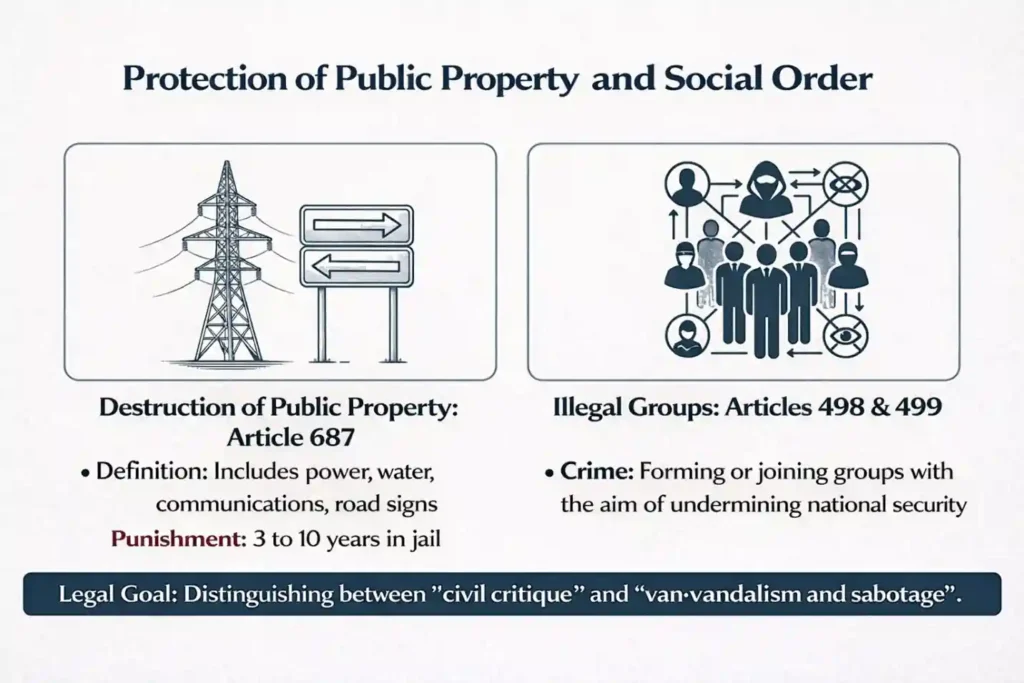
Article 687 – Anyone who intentionally destroys, sets fire to, disables, or commits any other sabotage in public facilities and installations such as water and sewage networks, electricity, oil, gas, post, telegraph and telephone, frequency and microwave centers (telecommunications), radio and television and related equipment, including dams, canals, branches, pipelines, power plants, transmission lines, aerial, ground or fiber optic cables, and devices for production, distribution, and transmission thereof, which have been established at government expense or with joint government and non-governmental capital or by the private sector for public use, as well as traffic signs and other signs installed to protect people’s lives or secure the above facilities or streets and roads, shall be sentenced to imprisonment from three to ten years, without the intent of disrupting public order and security.
(Note: If the aforementioned acts are committed with the purpose of disrupting public order and security and confronting the Islamic government, the punishment of mohareb shall apply.)
Article 498 – Anyone who, under any creed, forms or manages a group, population, or branch of a population of more than two persons inside or outside the country under any name or title with the aim of disrupting the security of the country and is not recognized as mohareb, shall be sentenced to imprisonment from two to ten years.
Article 499 – Anyone who joins one of the groups, populations, or branches of populations mentioned in Article 498 shall be sentenced to three months to five years imprisonment, unless it is proven that they were unaware of its objectives.
Article 610 – If two or more persons conspire and agree to commit crimes against the internal or external security of the country or prepare the means for committing them, and the title of mohareb does not apply to them, they shall be sentenced to two to five years imprisonment.
Article 512 – Anyone who incites or provokes people to war and killing against each other with the intent of disrupting the security of the country, regardless of whether it leads to murder and looting or not, shall be sentenced to one to five years imprisonment.
Article 618 – Anyone who, with clamor and uproar or unusual movements or assault on individuals, causes disruption of public order, comfort, and tranquility, or prevents people from earning a living, shall be sentenced to imprisonment from three months to one year and up to 74 lashes.
Article 183 – Anyone who takes up arms to create fear and terror and deprive people of freedom and security is a mohareb and mofsed fel-arz.
(Note 1: Someone who draws a weapon against people but due to incapacity causes fear to no one is not a mohareb.)
(Note 2: If someone draws their weapon with personal enmity motives against one or more specific persons and the act does not have a public aspect, they are not considered mohareb.)
(Note 3: There is no difference between cold and hot weapons.)
Article 675 – Anyone who intentionally sets fire to a building, structure, ship, airplane, factory, warehouse, or generally any residential place or suitable for habitation, or forest, threshing floor, or any type of agricultural product, trees, fields, or gardens belonging to another, shall be sentenced to imprisonment from two to five years.
You can download the PDF file from here